
Key considerations when deep-drawing metal stamping parts
Drawing turns a flat blank into an open hollow part under pressure from the punch. Four common approaches, and what governs the result in each.
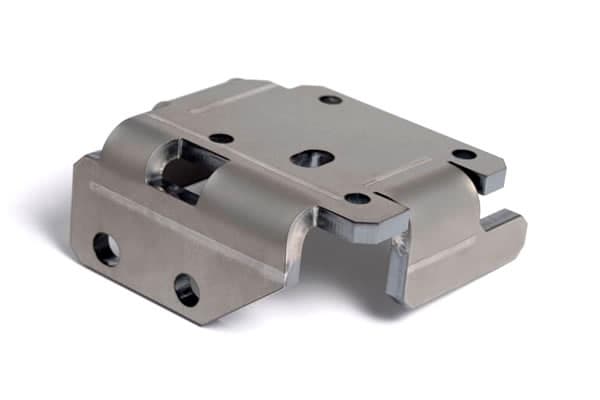
When a stamping has to be drawn to depth, the press forces a flat blank into the die cavity and the material flows rather than simply bending. Which approach applies depends on the shape, and each one fails in a different way if the blank development is wrong.
Panel drawing. Body panels and covers have complex curved surfaces, and the blank deforms in a genuinely complicated way: parts of it are being drawn inward while others are being stretched outward. Both mechanisms are present at once, so blank holder pressure has to be balanced around the perimeter rather than set to a single value.
Elliptical drawing. On an elliptical flange the deformation varies continuously around the profile. Where curvature is high the material undergoes more plastic strain; where it is nearly straight it undergoes less. Uneven strain means uneven thinning, which is why wall thickness should be checked at the tight radii and not just at the centre of the flat.
Stepped drawing. A stepped part is drawn in stages, with the deeper section formed early and the shallower section formed late. The side wall of the step is the vulnerable area: it sees shear as the second stage pulls material past the already-formed section, and it is where splits appear first.
Cylindrical drawing with a flange. This is the most forgiving case. The flange and base are flat, the side wall is axially symmetric, and deformation is distributed evenly around the circumference, so a single blank holder pressure works and the result is predictable.
In all four cases the practical advice is the same: prove the blank development on soft tooling before cutting a production die. Correcting a blank shape is cheap, and recutting a hardened die is not.